Check balls are critical wet-end components in a ball-type air-operated double-diaphragm pump. Each diaphragm pump check ball works with a valve seat as a one-way check system that controls the direction of fluid through the pump. If a ball is worn, swollen, damaged, obstructed, or incorrectly selected, the pump may lose prime, deliver low flow, produce unstable discharge, develop reduced pressure, allow fluid backflow, or fail to pump liquid.
Correct selection requires more than matching the ball diameter. Fluid properties, the valve seat, and the complete pump model influence whether a replacement will seal and move correctly. This guide explains what to inspect before ordering AODD pump wet-end parts.
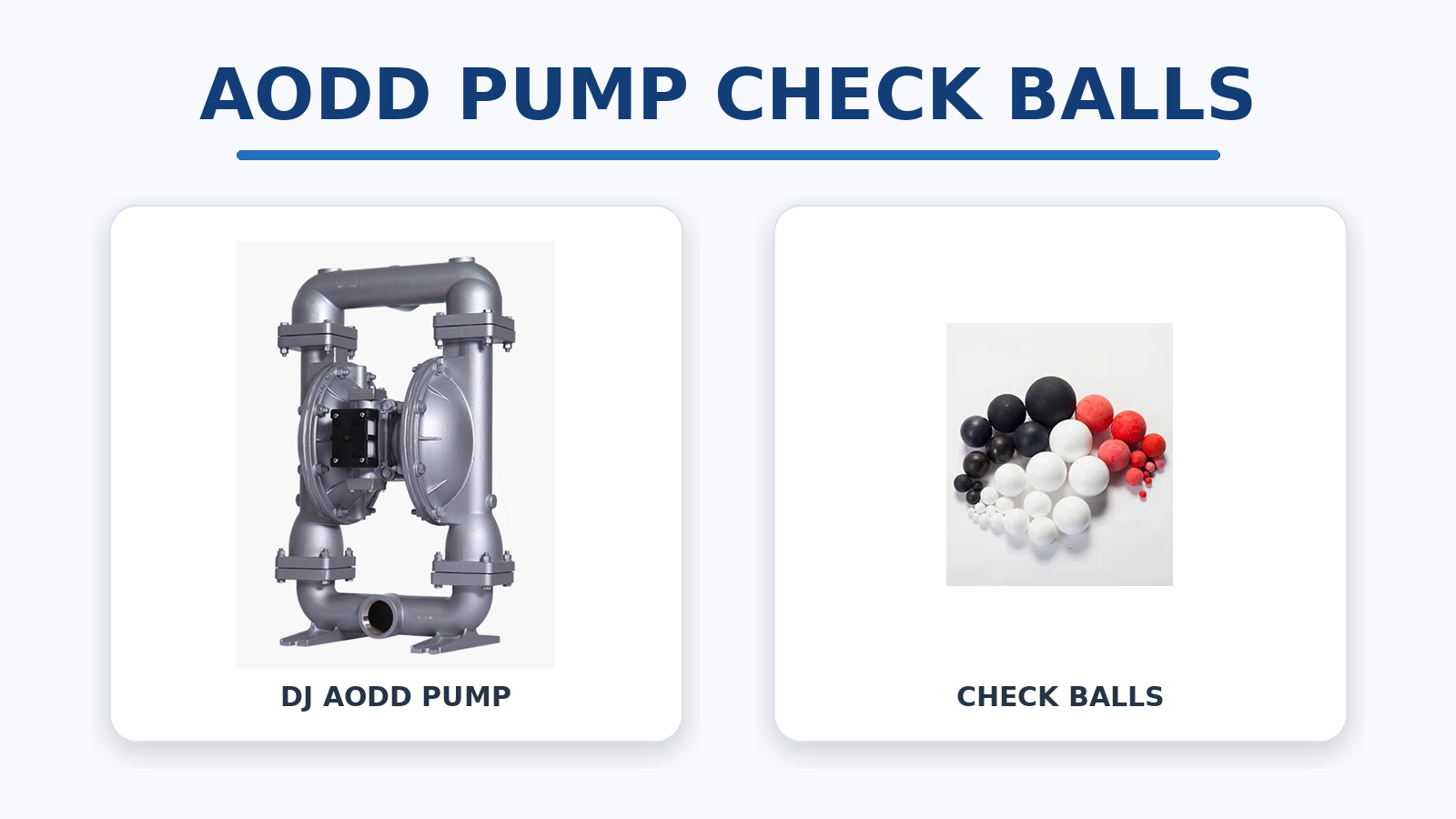
Table of Contents
What Is a Check Ball in an AODD Pump?
A check ball is the moving sealing element inside an inlet or outlet check assembly. During pump operation, pressure differences lift the ball away from its seat or press it back against the seat. This alternating action admits fluid to the chamber and then directs it toward the discharge manifold.
The ball normally operates together with three related parts:
- The valve seat, which provides the sealing surface
- A ball retainer or cage, which guides or limits ball movement
- Seals such as seat O-rings, which help prevent leakage around the assembly
The ball cannot seal reliably against a damaged, contaminated, incompatible, or incorrectly installed seat. Evaluate the diaphragm pump ball and seat as a pair.
A common ball-type AODD pump uses multiple inlet and outlet check assemblies. However, the exact quantity, arrangement, retainer design, and access method depend on the pump brand, size, and model. Do not assume that every pump has the same check structure.
Check Ball, Valve Ball and Ball Check Valve: What Is the Difference?
Several similar terms appear in manuals, quotations, and spare-parts inquiries. Their meaning depends on context.
| Term | Typical Meaning | Important Clarification |
|---|---|---|
| Check ball | The movable ball inside a one-way check assembly | It seals against a matching valve seat |
| Valve ball | Another common name for the internal check ball | Confirm that the inquiry concerns an AODD pump wet end |
| Ball check valve | The complete one-way check function or assembly using a ball | It may include the ball, seat, retainer, and seals |
| Ball valve AODD pump | An AODD pump that uses ball-type inlet and outlet checks | This distinguishes it from flap-valve or other check designs |
| Ball valve | Often a separate pipeline valve used for shutoff or flow isolation | Used alone, the term is ambiguous and may not mean a pump check ball |
For parts identification, “diaphragm pump valve ball” or “AODD pump check ball” is clearer than “ball valve.”
How Does an AODD Pump Check Ball Work?
The following description represents the general operating principle of many ball-type AODD pumps. Details can vary by pump design.
During the Suction Stroke
As the diaphragm moves and creates a pressure reduction in the fluid chamber, the inlet check ball lifts away from its seat. Fluid enters the chamber through the inlet passage. At the same time, the outlet check is driven toward its seat, helping reduce backflow from the discharge manifold.
During the Discharge Stroke
When the diaphragm moves in the opposite direction, it pushes fluid from the chamber. The inlet check ball seals against its seat to reduce reverse flow toward the suction manifold. The outlet check ball lifts, allowing fluid to enter the discharge manifold.
Poor ball-to-seat contact allows internal backflow and can reduce volumetric efficiency even while the air motor cycles.
Common AODD Pump Check Ball Materials
Check ball materials differ in flexibility, hardness, chemical resistance, temperature capability, wear behavior, and weight. Elastomer balls may provide flexible sealing in suitable applications. Rigid balls can offer different chemical, wear, and weight characteristics. No material is universally compatible.
| Check Ball Material | Main Characteristics | Typical Applications | Important Limitations |
|---|---|---|---|
| PTFE | Rigid, low surface adhesion, and resistant to many chemicals | Many chemical-transfer and solvent duties after compatibility review | May seal differently from an elastomer; weight and rigidity must suit the pump and fluid |
| Santoprene | Flexible thermoplastic elastomer with resilient sealing behavior | Water-based fluids and selected chemicals where its compatibility is suitable | Can swell, soften, or lose properties in incompatible fluids or temperatures |
| Buna-N or NBR | Flexible elastomer commonly used with many oils and compatible industrial fluids | Oils, lubricants, and selected general industrial liquids | Not suitable for every solvent, chemical, or elevated-temperature duty |
| EPDM | Flexible elastomer often considered for water-based fluids and selected chemicals | Water, some cleaning solutions, and selected chemical services | Generally unsuitable for many petroleum oils and hydrocarbons; verify exact compatibility |
| FKM or Viton | Elastomer offering resistance to many oils, fuels, and selected chemicals | Selected solvent, oil, and chemical applications | Not universally resistant; suitability varies with chemical, concentration, and temperature |
| Neoprene | Resilient general-purpose elastomer | Selected water-based and general industrial services | Chemical and temperature limitations must be reviewed for the actual fluid |
| Stainless steel | Rigid, durable, and relatively heavy | Selected abrasive, high-temperature, or chemically compatible duties | Can corrode in certain fluids and may not seal suitably in every seat or low-head condition |
Suitability depends on the exact fluid, concentration, temperature, and pump design. Ball weight can influence reseating, particularly with viscous fluids or unusual installations. This table is not a substitute for a chemical compatibility and application review.
How to Select the Correct Diaphragm Pump Check Ball Material
Chemical Compatibility
Identify the exact fluid name, composition, and concentration. Descriptions such as “chemical,” “solvent,” or “cleaner” are insufficient. Use the safety data sheet and reliable compatibility guidance, then confirm the complete wetted construction.
Fluid Temperature
Temperature can change both chemical compatibility and elastomer performance. A material that performs acceptably at room temperature may soften, harden, swell, or lose strength at a higher temperature. Evaluate concentration and temperature together rather than treating them as separate questions.
Fluid Viscosity
Viscous fluid can slow ball lift, limit suction performance, and delay reseating. Ball weight, pump speed, suction conditions, and check geometry must suit the actual viscosity.
Solids and Abrasion
Particles can wear sealing surfaces, become trapped between them, or restrict ball travel. Review particle size, hardness, concentration, and tendency to settle.
Sealing Performance
Flexibility, surface condition, ball weight, and seat matching influence sealing. A resilient ball may conform to a suitable seat, while a rigid ball relies on accurate geometry and clean contact surfaces.
Valve Seat Material
Evaluate the check ball together with the valve seats, seat O-rings, diaphragms, pump body material, and other wetted seals. A chemically resistant ball cannot protect an incompatible seat or O-ring.
A PTFE check ball does not automatically mean that every other wet-end component must also be PTFE. The correct combination depends on the pump design and application. Follow the model-specific construction options supported by the pump manufacturer or qualified parts supplier.
Common Symptoms of Worn or Damaged Check Balls
Check-ball and seat problems can produce several operating symptoms, but they are not the only possible causes.
| Pump Symptom | Possible Check Ball or Seat Cause | Recommended Inspection |
|---|---|---|
| Pump cycles but does not deliver liquid | Ball stuck open, severe seat damage, or incorrect assembly | Check free ball movement, assembly direction, and sealing surfaces |
| Pump cannot prime | Ball does not seal, ball is swollen, or seat is contaminated | Inspect balls, seats, suction-side checks, and residue |
| Pump repeatedly loses prime | Intermittent leakage at a ball-and-seat pair | Examine all inlet and outlet checks and suction connections |
| Flow is lower than expected | Restricted ball travel or leakage past a worn seat | Check cages, ball dimensions, wear, and solids obstruction |
| Discharge is unstable | Uneven check action or inconsistent sealing | Compare all balls and seats for wear and free movement |
| Fluid flows backward | A check remains open or cannot seal | Inspect for trapped debris, deformation, and seat damage |
| Pump produces irregular operating sounds | Ball movement is restricted or parts are incorrectly fitted | Inspect retainers, balls, seats, and assembly condition |
| Check ball becomes stuck | Swelling, dried product, solids, or an unsuitable ball size | Clean the assembly and verify material and dimensions |
Also check the air supply, diaphragms, suction piping, valve seats, seals, and installation conditions. Air leakage, a blocked inlet, excessive suction lift, or a damaged diaphragm can resemble a check-ball fault.
Common Causes of Check Ball Failure
Chemical attack may soften, crack, or otherwise degrade a ball. Swelling can increase its diameter and restrict movement, while hardening can reduce its ability to conform to the seat. Abrasive particles cause gradual wear, and sharp solids may produce cuts or surface damage.
Other common causes include:
- Ball deformation after incompatible service or prolonged stress
- Valve seat wear that prevents a complete sealing line
- Solid particles trapped between the ball and seat
- Incorrect material selection for the fluid or temperature
- Excessive pump speed that increases cycling and wear
- Incorrect assembly, orientation, or component matching
- Long-term normal wear during repeated operation
An apparent check-ball problem may originate from a damaged or contaminated valve seat. Replacing the ball alone can leave the symptom unresolved.
How to Inspect an AODD Pump Check Ball and Seat
Safety warning: Before disassembly, isolate the compressed-air supply, release trapped pressure, drain the pump, and follow the pump manufacturer’s service instructions. Handle hazardous fluid and contaminated components using the required site procedures and personal protective equipment.
During inspection:
- Check whether each ball remains round and consistent with the specified dimensions.
- Look for swelling, flattening, cuts, scratches, cracking, or other surface damage.
- Check whether an elastomer surface has hardened, softened, or become sticky.
- Confirm that the ball moves freely within its retainer or cage.
- Inspect the valve seat sealing edge for wear, grooves, chips, or distortion.
- Remove particles, fibers, crystals, or dried product from the contact surfaces.
- Inspect seat O-rings and nearby seals for deformation or chemical attack.
- Compare installed ball, seat, diaphragm, and seal materials with the current fluid requirements.
Do not improvise torque values or assembly procedures. Use instructions for the exact pump model.
When Should Check Balls Be Replaced?
There is no universal replacement interval. Inspect checks during scheduled wet-end maintenance and whenever pump performance changes.
Replacement should be considered when inspection finds:
- Visible wear, cuts, or surface damage
- Swelling, hardening, or softening
- Flattening or other deformation
- Chemical damage
- Inability to seal against a serviceable seat
- Repeated loss of prime associated with check leakage
- Material incompatibility after a fluid change
Replacing only the check ball may not solve the problem if the valve seat is also worn or damaged. Inspect all check assemblies so that uneven wear or a second damaged pair is not overlooked.
Check Ball Kit, Ball and Seat Kit or Complete Wet-End Kit?
Check Ball Kit
A check ball kit suits cases where the balls require replacement while other wet-end parts remain serviceable. Quantity and material must match the exact model.
Ball and Seat Kit
A ball and seat kit suits cases where both components show wear or the pump cannot maintain prime reliably.
Complete Wet-End Repair Kit
A complete wet-end repair kit is intended for broader fluid-side maintenance. Depending on brand, model, and part number, it may include:
- Diaphragms
- Check balls
- Valve seats
- O-rings
- Gaskets
- Other fluid-side sealing components
Review the kit contents because parts, materials, and quantities vary.
How to Identify the Correct Replacement Check Ball
Pump size alone is normally insufficient for check ball replacement. Pumps with the same nominal size may use different ball diameters, ball materials, seat designs, seat materials, part numbers, or regional and generation-specific configurations.
Provide the supplier with:
- Pump brand and complete pump model
- Pump size
- Serial number, if available
- Existing check ball material
- Valve seat material
- Pump body material
- Fluid name and concentration
- Fluid temperature
- Required quantity
- A clear pump nameplate photo
- An existing-part photo, if available
If available, include the verified original part number. Photos should show markings and the sealing surface.
Frequently Asked Questions
How many check balls are used in an AODD pump?
The quantity and arrangement depend on the pump design and model. Many ball-type pumps use multiple inlet and outlet checks, but confirm the parts diagram for the exact pump.
Can I replace only one check ball?
It may be physically possible, but inspect every ball and seat first. Uneven wear, shared service history, or unreliable sealing may justify check ball replacement as a matched set.
Are PTFE check balls better than rubber check balls?
Neither is universally better. Selection depends on chemical resistance, sealing behavior, temperature, wear, viscosity, ball weight, seat design, and operating conditions.
Why does a diaphragm pump lose suction?
Worn balls or seats are one possible cause. Suction leaks, blocked piping, excessive suction conditions, damaged diaphragms, incorrect assembly, and other installation or maintenance issues can also cause loss of suction.
Can a damaged check ball reduce pump flow?
Yes. Poor sealing allows internal backflow, while restricted ball movement can limit chamber filling or discharge. Either condition may reduce volumetric efficiency and delivered flow.
Should check balls and valve seats be replaced together?
Inspect them as a sealing pair. Replace them together when both show wear, when the seat can no longer provide an acceptable sealing surface, or when reliable sealing cannot otherwise be restored.
How do I identify the correct check ball part number?
Provide the complete pump model, original part number if available, ball and seat materials, nameplate photo, and existing-part photos. A check ball kit should be confirmed against the exact configuration.
What is the difference between a check ball and a ball valve?
A check ball is an internal moving component in a one-way check assembly. “Ball valve” may describe a pump check design, but it commonly refers to a separate pipeline shutoff valve. The context must be stated clearly.
Need a Replacement Diaphragm Pump Check Ball?
Send DJ PUMP the complete pump model, existing ball and seat materials, fluid information, and required quantity. We can help identify a suitable compatible check ball, valve seat, or wet-end repair kit for supported AODD pump models.