Selecting the correct body material is one of the most important steps when choosing an air-operated double-diaphragm pump.
Aluminum, stainless steel and polypropylene AODD pumps may offer similar basic operating principles, but they are designed for different fluids and working environments. Choosing the wrong material can lead to corrosion, contamination, leakage, premature component failure or unnecessary equipment cost.
There is no single material that is best for every application.
The correct choice depends on the chemical properties of the fluid, operating temperature, solids content, cleaning requirements, installation environment and safety requirements.
This guide compares the three most common AODD pump materials and explains when each one should be considered.
Table of Contents
Quick Comparison
| Factor | Aluminum | Stainless Steel | Polypropylene |
|---|---|---|---|
| Chemical resistance | Moderate | High for many fluids | High for many acids and alkalis |
| Pump weight | Relatively light | Heavy | Light |
| Mechanical strength | Good | Excellent | Moderate |
| Heat resistance | Generally good | Generally very good | Usually lower than metal pumps |
| Initial cost | Low to medium | High | Low to medium |
| Grounding capability | Yes, when properly grounded | Yes, when properly grounded | Standard PP is normally non-conductive |
| Typical applications | Paint, ink, oil, lubricants and general industrial fluids | Chemicals, solvents, corrosive fluids and demanding industrial processes | Acids, alkalis, water-treatment chemicals and corrosive water-based fluids |
This table is only a general comparison. Chemical concentration, temperature and pump construction can significantly change whether a material is suitable.
When Should You Choose an Aluminum AODD Pump?
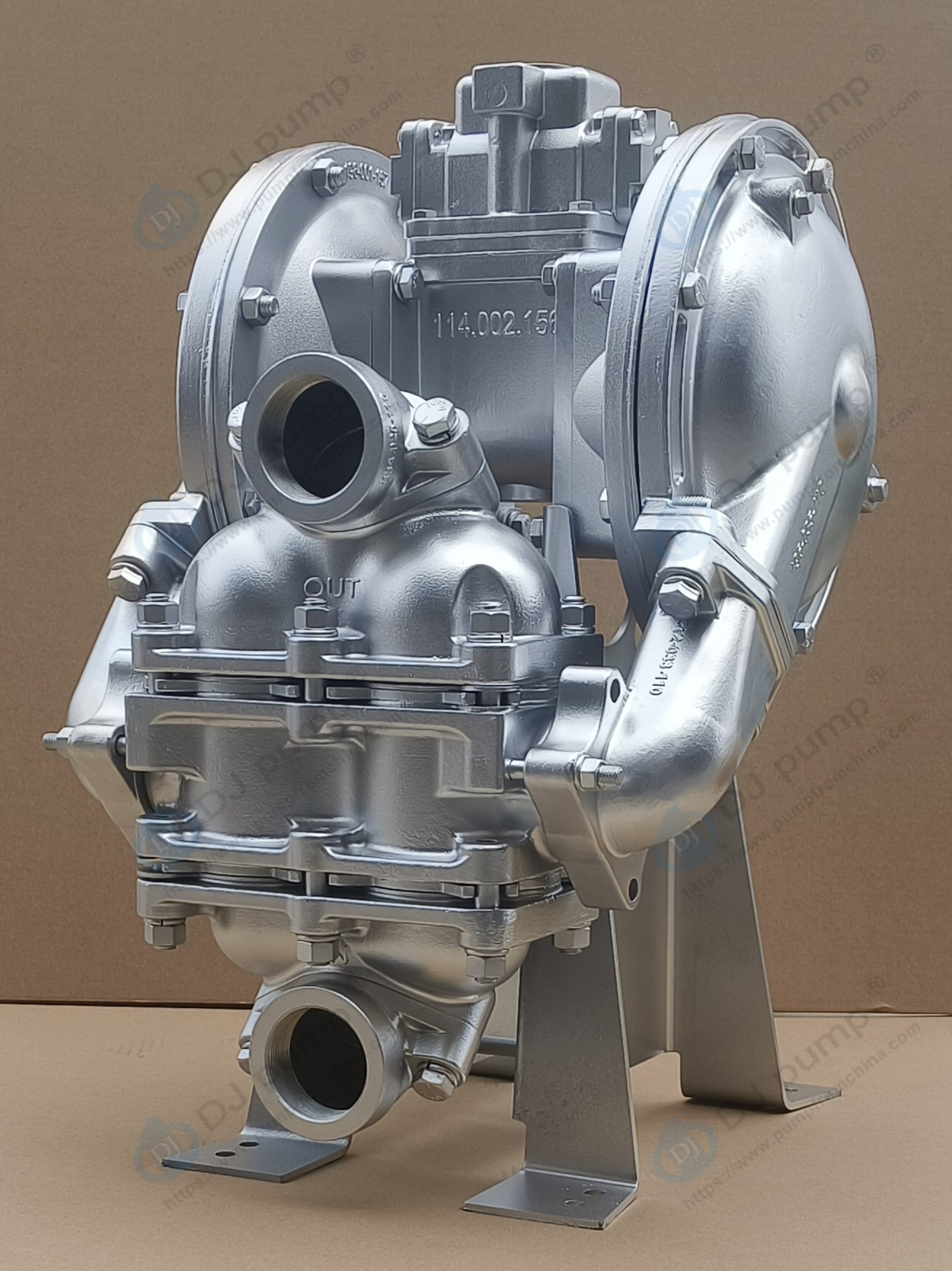
Aluminum is one of the most widely used materials for general industrial AODD pumps.
It provides a useful combination of mechanical strength, relatively low weight and competitive cost. Aluminum pumps are commonly selected for transferring paints, coatings, inks, oils, lubricants and compatible solvents.
Main Advantages of Aluminum Pumps
Lower weight than stainless steel
An aluminum pump is easier to move, install and use at portable transfer stations. This can be useful in paint plants, drum unloading areas and temporary production setups.
Competitive purchase cost
Aluminum pumps normally cost less than comparable stainless steel pumps, making them attractive for general industrial transfer applications.
Good mechanical strength
Compared with plastic pump bodies, aluminum normally provides better resistance to external impact and rough handling.
Suitable for many paint and coating applications
Aluminum AODD pumps are frequently used for transferring solvent-based paints, printing inks, resins, oils and other compatible industrial liquids.
Limitations of Aluminum Pumps
Aluminum is not suitable for every chemical.
Strong acids, strong alkalis and certain corrosive chemicals may attack the aluminum wetted components. Chemical reaction can damage the pump and may also contaminate the transferred product.
The suitability of aluminum must therefore be checked against the exact fluid, concentration and operating temperature.
Typical Aluminum Pump Applications
- Paint and coating transfer
- Printing ink circulation
- Lubricant and oil transfer
- Solvent transfer, subject to compatibility confirmation
- Adhesive and resin transfer
- General industrial liquid transfer
- Portable drum and container unloading
An aluminum pump is often the practical choice when the liquid is compatible, sanitary construction is not required and the customer wants a durable pump at a reasonable cost.
When Should You Choose a Stainless Steel AODD Pump?
Stainless steel is generally selected for demanding applications that require higher corrosion resistance, mechanical strength, cleanliness or durability.
A stainless steel AODD pump is heavier and more expensive than an aluminum or polypropylene pump, but it may provide a longer service life under suitable operating conditions.
Main Advantages of Stainless Steel Pumps
High mechanical strength
Stainless steel pump bodies are suitable for demanding industrial environments, frequent operation and installations where the pump may experience physical stress.
Broad chemical compatibility
Stainless steel is compatible with many chemicals, solvents, oils and industrial fluids. However, it is not universally corrosion-proof. Chloride-containing fluids, strong acids and other aggressive chemicals may still cause corrosion depending on concentration and temperature.
Better suitability for elevated temperatures
Metal pumps generally tolerate higher fluid temperatures than standard polypropylene pumps. The actual maximum temperature still depends on the pump model, diaphragm, valve ball, valve seat and sealing materials.
Easy-to-clean surface
Stainless steel is often selected when cleanliness is important. However, a standard industrial stainless steel pump should not automatically be described as a sanitary or food-grade pump.
Food, dairy and pharmaceutical applications may require special sanitary construction, certified elastomers, suitable surface finishing, hygienic connections and compliance with relevant standards.
Limitations of Stainless Steel Pumps
The main disadvantages are higher cost and greater weight.
Stainless steel is also not suitable for every corrosive chemical. The exact grade of stainless steel and the composition of all wetted parts must be confirmed.
Typical Stainless Steel Pump Applications
- Chemical processing
- Solvent transfer
- Industrial cleaning chemicals
- Resin and adhesive transfer
- Paint and coating production
- Pharmaceutical and cosmetic ingredients, using a suitable sanitary design
- Food and beverage transfer, using a suitable certified hygienic pump
- High-value or contamination-sensitive fluids
- Demanding industrial installations
Stainless steel is usually the better choice when durability, cleanliness and broader chemical resistance are more important than initial purchase cost.
When Should You Choose a Polypropylene AODD Pump?
Polypropylene, commonly abbreviated as PP, is a popular non-metallic material for transferring corrosive chemicals.
PP pumps are lightweight and resistant to many acids, alkalis and water-treatment chemicals. They are widely used in chemical transfer, wastewater treatment, surface treatment and general corrosive-fluid applications.
Main Advantages of Polypropylene Pumps
Resistance to many acids and alkalis
Polypropylene can be a suitable option for many water-based corrosive chemicals that would attack aluminum.
Lightweight construction
PP pumps are easier to transport, install and move between different operating locations.
No metal corrosion of the pump body
Because the fluid chambers and manifolds are made from plastic, they do not experience conventional metallic rust.
Competitive cost
A polypropylene pump can provide an economical solution for many chemical applications where stainless steel would be unnecessarily expensive.
Limitations of Polypropylene Pumps
Polypropylene is not compatible with every chemical.
Certain solvents, hydrocarbons, oxidizing chemicals and high-temperature fluids may damage or weaken the material. Compatibility must always be checked using the exact chemical name, concentration and temperature.
PP also has lower mechanical strength and impact resistance than metal. Piping loads, unsupported hoses, excessive tightening and external impact may damage plastic ports or manifolds.
Important Safety Note for Flammable Fluids
Standard polypropylene is normally non-conductive.
A standard non-conductive PP pump should not automatically be used for flammable or combustible liquids because static electricity may not be safely dissipated.
Conductive polypropylene pump versions are available for some applications, but the complete pump configuration, grounding method and relevant certification must be confirmed before use.
Never assume that every black or dark-colored plastic pump is conductive.
Typical Polypropylene Pump Applications
- Acids and alkalis
- Water-treatment chemicals
- Wastewater-treatment chemicals
- Detergents and cleaning solutions
- Electroplating chemicals
- Water-based chemicals
- Fertilizer and agricultural chemicals
- General corrosive liquid transfer
A PP pump is often the most economical choice when the chemical is compatible, the temperature is within the permitted range and a non-metallic fluid section is preferred.
Aluminum vs Stainless Steel vs Polypropylene: How to Decide
The pump material should be selected by evaluating the complete operating conditions rather than only the fluid name.
1. Confirm the Exact Fluid
General descriptions such as “chemical,” “paint,” “solvent” or “cleaning liquid” are not enough.
Provide the full chemical name or product data sheet whenever possible. A paint may be water-based or solvent-based, while a cleaning solution may contain acids, alkalis, solvents or oxidizing agents.
These differences can completely change the correct pump material.
2. Check Concentration
The same chemical may have different compatibility at different concentrations.
For example, a diluted cleaning solution may be suitable for a material that cannot safely handle the concentrated version.
3. Check the Fluid Temperature
Chemical resistance can decrease as temperature increases.
A material that performs well at room temperature may soften, corrode or lose strength at an elevated temperature. Always evaluate chemical concentration and temperature together.
4. Identify Flammability and Grounding Requirements
When transferring flammable liquids, check whether the pump and the complete fluid system can be properly grounded.
Metal pumps must still be correctly grounded. Standard non-conductive plastic pumps require additional attention and should not be selected without a proper safety assessment.
5. Consider Solids and Abrasion
The pump body is only one part of the selection.
Fluids containing pigments, powders, crystals or abrasive particles may require suitable valve balls, seats, diaphragms and pump speed control.
In abrasive applications, running a larger pump at a lower cycle rate may sometimes reduce component wear compared with operating a smaller pump continuously at high speed.
6. Consider Cleaning and Contamination
If the fluid must remain clean, check the complete wetted construction.
A stainless steel pump body alone does not guarantee sanitary performance. Internal surface finish, dead spaces, connection type, diaphragm design and cleaning procedures must also be considered.
7. Compare Total Cost, Not Only Purchase Price
The cheapest pump is not always the least expensive solution.
A low-cost pump that is incompatible with the fluid may require frequent repairs or replacement. A more suitable material may reduce downtime, leakage and spare-parts consumption.
The Diaphragm and Valve Materials Are Equally Important
Choosing the correct body material does not complete the pump selection.
The following wetted components must also be compatible with the fluid:
- Diaphragms
- Valve balls
- Valve seats
- O-rings and gaskets
- Fluid-side shafts or fasteners
- Manifold seals
- Port connections
Common diaphragm and valve materials include PTFE, Santoprene, Buna-N, EPDM and FKM.
For example, an aluminum pump body may be compatible with a paint, but the wrong diaphragm or valve material may swell, harden or fail after contact with the solvent.
The complete material combination must therefore be reviewed.
Common Selection Mistakes
Assuming Stainless Steel Is Always the Best
Stainless steel offers excellent strength and broad chemical resistance, but it is more expensive and is not resistant to every chemical.
For many compatible paints, oils and general industrial liquids, aluminum may be more economical.
For certain acids and alkalis, polypropylene may provide better compatibility than standard stainless steel.
Selecting a Pump Based Only on Price
Initial pump cost should not be the only factor.
Chemical damage, diaphragm failure, leakage and production downtime can cost much more than the difference between two pump materials.
Ignoring Temperature
A chemical compatibility chart based on room temperature may not apply to a heated fluid.
Describing Every Stainless Steel Pump as Food Grade
A standard stainless steel industrial pump is not necessarily suitable for dairy, beverage or pharmaceutical production.
Sanitary applications require a specially designed and appropriately certified pump.
Using Standard PP for Flammable Solvents
Standard polypropylene is normally non-conductive. Flammable-fluid applications require a pump and installation specifically designed for safe static dissipation and grounding.
Frequently Asked Questions
Is stainless steel always better than aluminum?
No. Stainless steel normally offers greater strength and broader chemical resistance, but it is heavier and more expensive. Aluminum may be the better option for compatible paints, oils, inks and general industrial liquids.
Can a polypropylene pump transfer solvents?
It depends on the exact solvent, concentration and temperature. Some solvents may be compatible, while others can soften, swell or damage polypropylene. The complete pump configuration must be checked before selection.
Is aluminum suitable for paint transfer?
Aluminum AODD pumps are commonly used for many paint, coating, ink and resin applications. However, the complete chemical composition of the fluid and the diaphragm material must still be confirmed.
Is a stainless steel AODD pump automatically food grade?
No. A food-grade or sanitary pump may require hygienic construction, certified materials, suitable surface finishing, sanitary connections and compliance with specific standards.
Which material is the least expensive?
Aluminum and polypropylene pumps generally have a lower initial cost than stainless steel pumps. Actual pricing depends on pump size, port type, diaphragm material and configuration.
What information is required to select the correct pump?
Provide the following information:
- Fluid name and composition
- Concentration
- Operating temperature
- Required flow rate
- Required discharge pressure or head
- Viscosity
- Maximum solids size
- Flammability
- Cleaning requirements
- Preferred connection type
- Required certification
Final Recommendation
Choose an aluminum AODD pump for compatible paints, inks, oils, lubricants and general industrial fluids when low weight and competitive cost are important.
Choose a stainless steel AODD pump when higher strength, cleanliness, durability or broader chemical resistance is required.
Choose a polypropylene AODD pump for many compatible acids, alkalis, water-treatment chemicals and corrosive water-based fluids.
However, the final selection should never be based on the pump body material alone.
Chemical concentration, temperature, diaphragms, valve materials, solids, grounding requirements and certification must all be considered.
DJ PUMP supplies aluminum, stainless steel and polypropylene AODD pumps in multiple sizes and material configurations.