
Table of Contents
Introduction
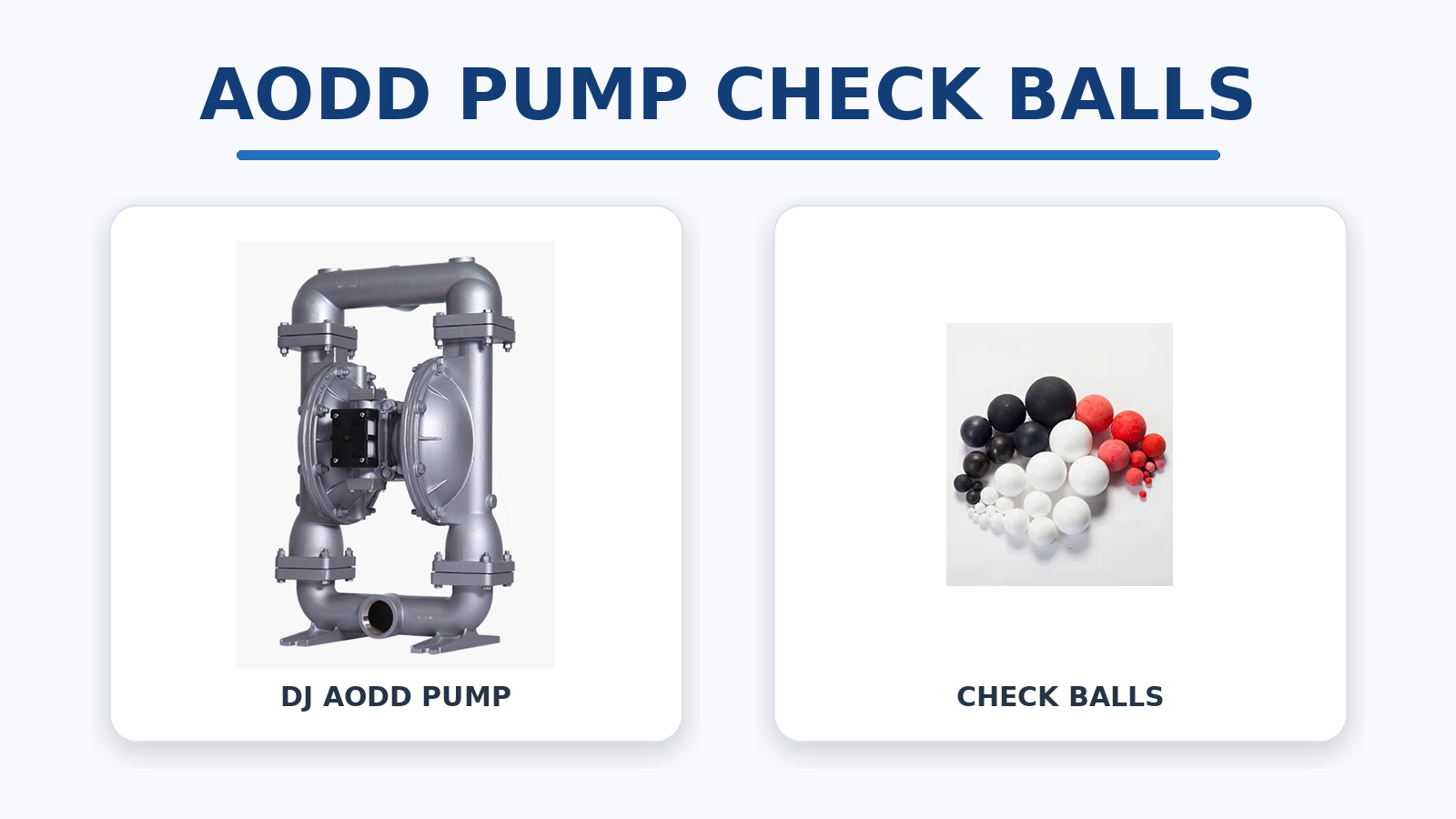
Air operated diaphragm pumps (AODD pumps) are widely used in the paint and coating industry due to their flexibility, safety in hazardous environments, and ability to handle a wide range of fluids.https://www.pumps.org/standards/aodd-pumps/
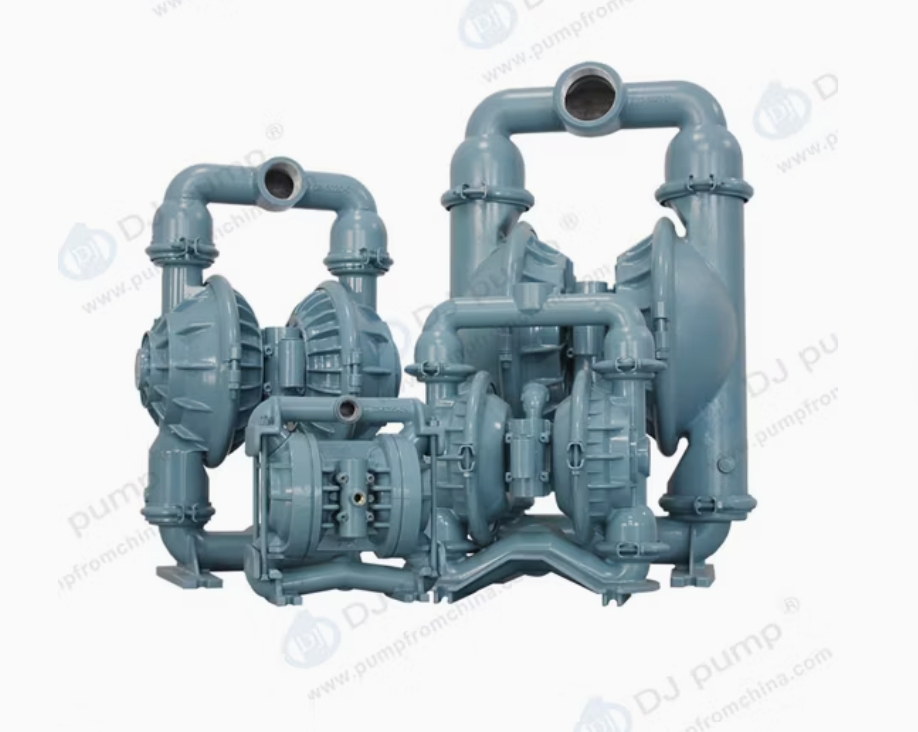
However, when it comes to actual pump selection, there is often confusion between different designs:
- Standard ball valve AODD pumps
- Heavy-duty ball valve AODD pumps
- Flap valve AODD pumps
At first glance, it may seem logical that “heavier-duty” pumps should always be preferred, especially in an industry dealing with pigments, solids, and varying viscosity.
But in real coating plants, the situation is more nuanced.
This article explains how these three pump types are actually used, and why standard industrial ball valve AODD pumps remain the dominant choice.
1. The Nature of Coating Processes: Not Just “Heavy Duty”
Paint and coating manufacturing is often misunderstood as a purely “heavy-duty” process. In reality, it is a combination of:
- Abrasive handling (pigments and fillers)
- Shear-sensitive systems (dispersed coatings)
- Flammable environments (solvent-based products)
- Frequent process changes (batch production)
This means pump selection is not based only on strength or durability, but on a balance between:
- Flow stability
- Material compatibility
- Process control
- Maintenance practicality
2. Standard Ball Valve AODD Pumps: The Industry Workhorse
2.1 What “Standard” Actually Means
Standard ball valve AODD pumps used in coating plants are not light-duty equipment. They are typically:
- Industrial-grade pumps
- Designed for continuous operation
- Compatible with moderate solids and viscosity
They represent a balanced design, rather than a minimal one.
2.2 Why They Are Widely Used
In most coating processes, standard ball valve pumps offer the best overall performance.
Stable Flow Behavior
In operations such as:
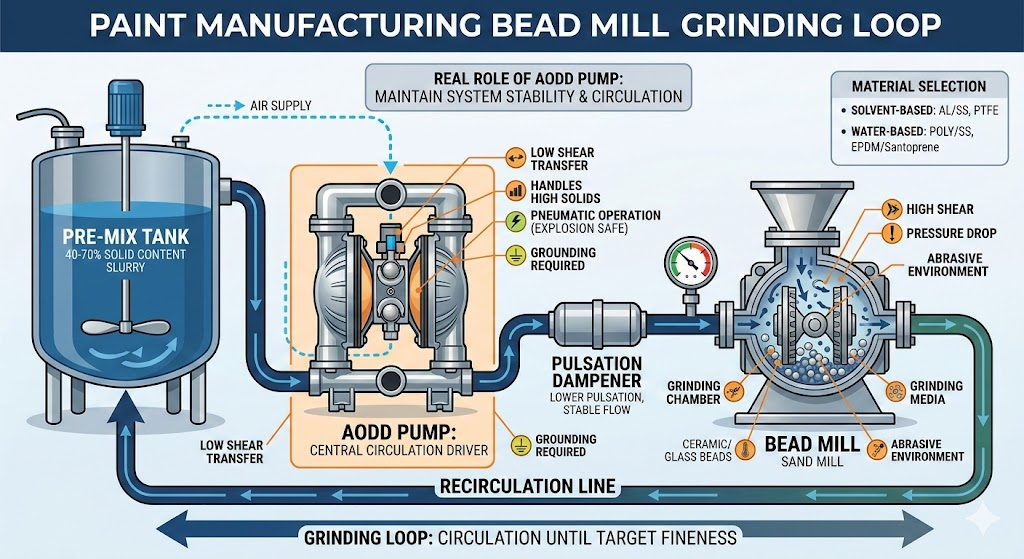
- Bead mill feeding
- Filtration transfer
- Filling lines
Flow consistency is more important than maximum output.
Standard ball valve pumps provide:
- Predictable cycling
- Controlled flow under varying pressure
- Better process repeatability
Adequate Solids Handling
While coatings contain solids, they are typically:
- Controlled in particle size
- Properly dispersed before final stages
This means extreme solids-handling capability is not always required.
Good Sealing for Solvent Systems
In solvent-based coatings, sealing performance is critical.
Ball valve designs provide:
- Reliable shut-off
- Reduced leakage
- Safer operation in VOC environments
Lower System Disturbance
Compared to more aggressive designs, standard ball valve pumps:
- Produce manageable pulsation
- Minimize disturbance to sensitive dispersions
This is particularly important for finished or semi-finished coatings.
2.3 Typical Applications
Standard ball valve pumps are used across:
- Raw material transfer
- Grinding circulation
- Filtration systems
- Finished product handling
They are the default choice in most plants.
3. Heavy-Duty Ball Valve AODD Pumps: When Extra Strength Is Needed
3.1 What Makes Them “Heavy-Duty”
Heavy-duty ball valve pumps are designed with:
- Reinforced diaphragms
- Larger flow passages
- Stronger valve components
- Higher tolerance to wear and pressure
3.2 Where They Are Used
They are typically selected for more demanding conditions:
- High-solid pigment slurry before dispersion
- Abrasive materials (e.g., titanium dioxide concentrates)
- High-viscosity mixtures
- Difficult suction conditions
3.3 Why They Are Not Always the First Choice
Despite their strength, heavy-duty pumps are not always preferred because:
- They may introduce stronger pulsation
- Flow control can be less refined
- Cost and maintenance are higher
In many coating processes, these factors outweigh the benefits of increased durability.
4. Flap Valve AODD Pumps: Designed for Problem Materials
4.1 Structural Characteristics
Flap valve pumps eliminate spherical valve balls and use flexible flaps, allowing:
- Larger internal passages
- Passage of larger particles
- Reduced risk of clogging
4.2 Typical Applications in Coating Plants
They are mainly used in:
- Handling settled pigment at tank bottoms
- Transferring very thick or non-uniform slurry
- Cleaning and residue recovery
4.3 Limitations
However, flap valve pumps have several drawbacks:
- Poor sealing compared to ball valves
- Higher pulsation
- Less stable flow
- Limited suitability for precise processes
Because of this, they are rarely used in:
- Grinding circulation
- Filtration
- Finished coating transfer
- Filling systems
5. Practical Selection Logic in Paint Plants
In real-world coating operations, pump selection usually follows a practical approach:
- Standard ball valve AODD pumps → general production use
- Heavy-duty ball valve pumps → demanding or abrasive stages
- Flap valve pumps → problem-solving for difficult materials
This layered approach allows plants to optimize both performance and cost.
Conclusion
In the paint and coating industry, pump selection is not about choosing the “strongest” option, but the most appropriate one.
Standard ball valve AODD pumps dominate because they provide the best balance of:
- Flow stability
- Sealing performance
- Process compatibility
- Operational efficiency
Heavy-duty and flap valve pumps serve important roles, but mainly in specific situations rather than as general solutions.
Understanding these differences allows engineers to design more reliable systems and avoid unnecessary over-specification.