A pulsation dampener for AODD pumps is an important device used in air operated double diaphragm pump systems to reduce pressure fluctuation and stabilize flow.Because an AODD pump works by the reciprocating movement of two diaphragms, the discharge flow is naturally not completely continuous. In many industrial fluid transfer systems, this pulsating flow can cause pressure fluctuation, pipeline vibration, water hammer, noise, unstable spraying, inaccurate filling, and faster wear of valves, meters, hoses, and other downstream equipment.
A pulsation dampener, also called a pulsation damper, surge dampener, surge suppressor, or pulsation suppressor, is designed to absorb these pressure pulses and provide a smoother, more stable flow. For industries such as paint and coatings, chemical processing, ceramics, mining, wastewater treatment, printing ink, resin transfer, and slurry handling, installing the correct pulsation dampener can greatly improve system stability and reduce maintenance problems.
Inhoudsopgave
Why Do AODD Pumps Create Pulsation?
Air operated diaphragm pumps are positive displacement pumps. During operation, compressed air drives the diaphragms to move back and forth. One chamber draws liquid in while the other chamber discharges liquid out. This alternating movement gives AODD pumps many advantages, such as self-priming, dry-running capability, safe pneumatic operation, and strong chemical compatibility.
However, this working principle also creates discharge pulsation. The flow is delivered in repeated pulses rather than as a perfectly continuous stream. In low-pressure or simple transfer applications, this may not be a serious problem. But in many production lines, especially where stable flow is required, pulsation may lead to:
- pipeline shaking and vibration
- water hammer
- unstable pressure
- noisy operation
- uneven spray patterns
- poor coating quality
- inaccurate dosing or filling
- damage to pressure gauges and flow meters
- shorter hose and valve service life
- higher maintenance frequency
This is why a diaphragm pump pulsation dampener is often recommended for AODD pump systems.
What is a pulsation dampener for AODD pumps?
A pulsation dampener is a device installed near the pump discharge outlet to reduce pressure fluctuation and smooth the fluid flow. It uses an air chamber and a flexible diaphragm or bladder to absorb the energy of each pressure pulse.
When the pump discharge pressure rises, part of the fluid energy is absorbed by the dampener. When the pressure drops, the stored energy is released back into the pipeline. This process reduces the peak-to-peak pressure fluctuation and helps create a more stable flow.
In the market, customers may use different names for the same type of product, including:
- Pulsation Dampener
- Pulsation Damper
- Surge Dampener
- Surge Suppressor
- Pulsation Suppressor
- AODD Pump Dampener
- Diaphragm Pump Surge Dampener
- Air Diaphragm Pump Accessories
- Diaphragm Pump Pulsation Dampener
For AODD pump applications, “pulsation dampener” and “surge dampener” are the most common search terms.
How does a pulsation dampener for AODD pumps work?
A pulsation dampener normally has two main sections: the liquid side and the air side. The liquid side contacts the transferred fluid, while the air side provides a compressible cushion. A diaphragm separates the liquid from the compressed air.
When liquid pressure increases, the diaphragm moves toward the air chamber and compresses the air. When liquid pressure decreases, the compressed air pushes the diaphragm back and releases energy into the pipeline. This continuous absorption and release process reduces pulsation and pressure shock.
For air operated diaphragm pump systems, this is especially useful because the pump discharge flow changes with air pressure, back pressure, viscosity, stroke speed, and pipeline conditions.
Main Benefits of Using a Pulsation Dampener
A correctly selected pulsation dampener can bring several practical benefits to industrial fluid transfer systems.
First, it helps provide smoother flow. This is important for coating, spraying, filtration, filling, and metering applications where unstable flow can affect product quality.
Second, it reduces pipeline vibration. Excessive vibration may loosen bolts, damage pipe supports, create leakage at flange connections, and shorten hose service life.
Third, it helps reduce water hammer and pressure shock. This protects valves, instruments, flow meters, pressure gauges, filters, and other downstream equipment.
Fourth, it can improve process consistency. In paint and coating production, for example, smoother flow can help reduce uneven spraying, coating defects, and material waste.
Fifth, it helps reduce noise and maintenance cost. A more stable pipeline system normally means less mechanical stress and fewer unexpected shutdowns.
Automatic vs Manual Pulsation Dampener
There are two common types of pulsation dampeners for AODD pump systems: automatic type and manual type.
Automatic Pulsation Dampener
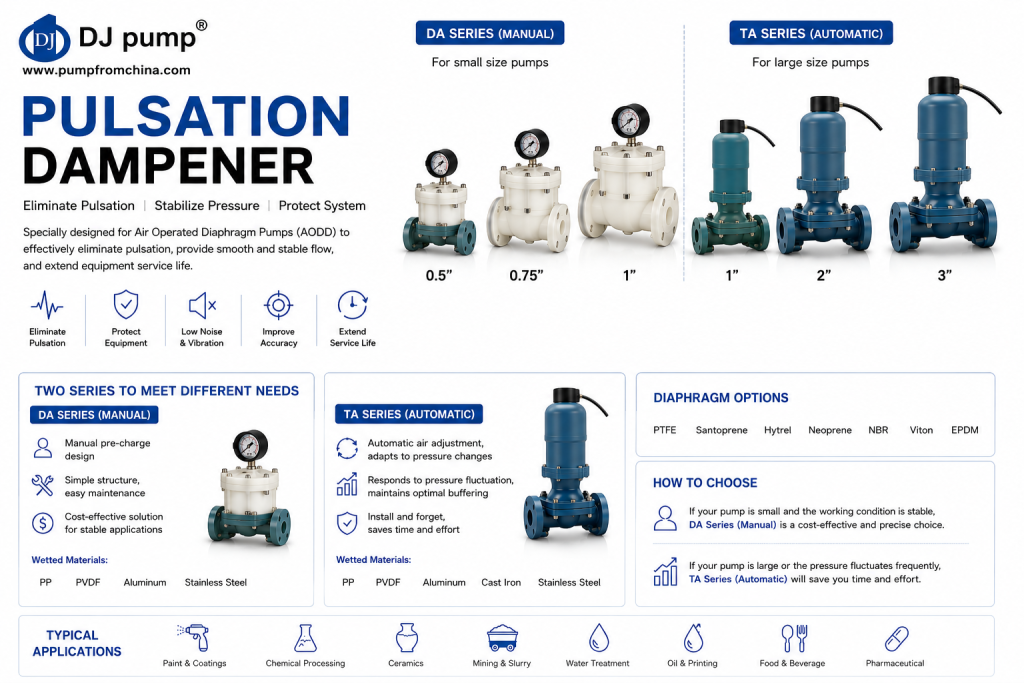
An automatic pulsation dampener can adjust the air chamber according to pipeline pressure changes. It is especially suitable for large flow applications, long pipelines, frequent pressure fluctuation, and operating conditions where the pump flow or back pressure changes during production.
DJ TA Series is an automatic pulsation dampener series designed for larger AODD pump systems. It helps maintain an effective buffering condition without frequent manual adjustment.
Typical applications include:
- large-flow chemical transfer
- paint and coating production
- ceramic slurry transfer
- mining slurry handling
- wastewater treatment
- long-distance pipeline transfer
- high-frequency pressure fluctuation systems
Manual Pulsation Dampener
A manual pulsation dampener requires manual pre-charge adjustment to match the pump operating pressure. It has a simple structure and is suitable for small pumps, stable pressure conditions, and applications where cost-effectiveness is important.
DJ DA Series is a manual pulsation dampener series designed for small AODD pump systems. It is suitable for compact installations and stable working conditions.
Typical applications include:
- small pump transfer systems
- laboratory or pilot production
- small-batch chemical transfer
- stable coating or ink transfer
- low to medium flow applications
DJ TA Series Automatic Pulsation Dampener
DJ TA Series automatic pulsation dampeners are designed for medium and large AODD pump applications. They are available in different sizes and materials to match various working conditions.
Available sizes include:
- 1 inch
- 1.5 inch
- 2 inch
- 3 inch
Available wetted materials include:
- PP
- PVDF
- Aluminum
- Cast Iron
- Stainless Steel
PP and PVDF TA Series dampeners are suitable for many chemical and corrosive liquid applications. Aluminum and cast iron versions are commonly used for general industrial fluids, paint, coating, oil, wastewater, and slurry transfer. Stainless steel versions are suitable for applications requiring better strength, durability, or corrosion resistance.
For PP and PVDF automatic pulsation dampeners, air chamber options can include aluminum air chamber or stainless steel air chamber. If the working environment contains corrosive gas or requires better corrosion resistance on the air side, a stainless steel air chamber can be considered.
DJ DA Series Manual Pulsation Dampener
DJ DA Series manual pulsation dampeners are designed for smaller AODD pumps and stable operating conditions. They provide a simple, economical, and practical solution for reducing pulsation in compact fluid transfer systems.
Available sizes include:
- 0.5 inch
- 0.75 inch
- 1 inch
Available wetted materials include:
- PP
- PVDF
- Aluminum
- Stainless Steel
The DA Series is suitable for small pump applications where the operating pressure does not change frequently. Because the structure is simple and easy to maintain, it is a good choice for users who need a cost-effective pulsation reduction solution.
How to Choose the Right Material
Material selection is very important because the wetted parts must be compatible with the transferred liquid.
PP pulsation dampeners are commonly used for general chemical transfer, water treatment, and many corrosive liquids.
PVDF pulsation dampeners offer stronger chemical resistance and are suitable for more aggressive chemicals.
Aluminum pulsation dampeners are often used for paint, coating, oil, solvents, and general industrial applications.
Cast iron pulsation dampeners are suitable for heavy-duty industrial conditions where strength and durability are required.
Stainless steel pulsation dampeners are suitable for corrosive liquids, high-strength requirements, food-related applications, and processes that require cleaner or more durable metallic materials.
The final selection should always consider the fluid name, concentration, temperature, pressure, solids content, viscosity, and installation environment.
Applications in Paint and Coating Industry
In paint and coating production, AODD pumps are widely used for solvent transfer, resin transfer, pigment slurry handling, bead mill feeding, filtration, circulation, and finished product filling. These processes often require stable flow and reliable chemical compatibility.
Without a pulsation dampener, pressure fluctuation may cause unstable feeding, uneven spraying, pipeline vibration, and poor filling accuracy. For high-solid coatings, pigment slurry, ceramic coating, latex paint, water-based paint, solvent-based paint, ink, and resin systems, a pulsation dampener can help improve flow stability and reduce production problems.
For paint and coating applications, common choices include aluminum, stainless steel, PP, or PVDF pulsation dampeners, depending on the liquid composition and working environment.
Applications in Chemical Processing
Chemical plants often use air operated diaphragm pumps because they can handle corrosive, flammable, viscous, or shear-sensitive fluids. However, chemical pipelines may include filters, valves, flow meters, and long pipe runs that are sensitive to pressure pulses.
A chemical pulsation dampener helps reduce pressure shock, protect instruments, and improve flow consistency. PP and PVDF dampeners are often selected for corrosive chemicals, while stainless steel dampeners may be selected for stronger mechanical performance or special chemical compatibility requirements.
Applications in Mining and Slurry Transfer
Mining slurry, ceramic slurry, and abrasive liquid transfer can create severe pipeline vibration. When a large AODD pump is used for slurry handling, the repeated discharge pulses may damage pipeline supports, loosen flange connections, and increase noise.
A large-size automatic pulsation dampener can help reduce vibration and stabilize the transfer system. For heavy-duty slurry applications, material selection should consider both corrosion resistance and abrasion resistance.
Where Should a Pulsation Dampener Be Installed?
In most AODD pump systems, the pulsation dampener should be installed as close as possible to the pump discharge outlet. This allows the dampener to absorb pressure pulses before they travel through the pipeline.
Common installation suggestions include:
- install near the pump outlet
- keep the connection short
- match the dampener size with the pump size
- select compatible wetted materials
- check the connection type before installation
- avoid installing too far away from the pump
- follow operating pressure requirements
- use proper supports for large-size dampeners
Correct installation is just as important as correct selection.
Common Selection Mistakes
One common mistake is choosing a dampener that is too small. If the dampener volume is not enough for the pump flow and pressure fluctuation, the buffering effect may be limited.
Another mistake is choosing the wrong material. A low-cost material may fail quickly if it is not compatible with the transferred chemical.
A third mistake is ignoring the installation position. A dampener installed far away from the pump may not effectively absorb the initial pressure pulses.
A fourth mistake is using a manual dampener in a system with frequent pressure changes. In such cases, an automatic pulsation dampener is usually more suitable.
FAQ
What is the difference between a pulsation dampener and a surge dampener?
In many industrial pump applications, the two terms are used interchangeably. “Pulsation dampener” focuses on reducing the repeated discharge pulses created by positive displacement pumps, while “surge dampener” often refers to reducing pressure surge or water hammer. For AODD pumps, both terms are commonly used.
Do all AODD pumps need a pulsation dampener?
Not every AODD pump system needs one. Simple transfer applications may work without a dampener. However, if the system has vibration, noise, pressure fluctuation, water hammer, unstable spraying, inaccurate filling, or sensitive downstream instruments, a pulsation dampener is recommended.
Should I choose an automatic or manual pulsation dampener?
For large pumps, high-flow systems, long pipelines, and frequently changing pressure conditions, an automatic pulsation dampener is usually more suitable. For small pumps and stable operating conditions, a manual pulsation dampener can be a more economical choice.
What size pulsation dampener do I need?
In many cases, the dampener size is selected according to the pump size. For example, a 1 inch pump is often matched with a 1 inch dampener, and a 2 inch pump is often matched with a 2 inch dampener. However, actual selection should also consider flow rate, pressure, pipeline length, viscosity, and required pulsation reduction level.
Can a pulsation dampener be used for paint and coating transfer?
Yes. Pulsation dampeners are commonly used in paint and coating systems to improve flow stability, reduce pipeline vibration, and support more consistent spraying, filtration, circulation, and filling processes.
Conclusion
A pulsation dampener is an important accessory for air operated diaphragm pump systems. It helps reduce pulsation, stabilize pressure, protect pipelines, reduce water hammer, and improve overall system reliability. For industries such as paint and coatings, chemical processing, ceramics, mining, wastewater treatment, and slurry transfer, selecting the right pulsation dampener can reduce maintenance problems and improve production stability.
DJ provides both TA Series automatic pulsation dampeners and DA Series manual pulsation dampeners, with materials including PP, PVDF, Aluminum, Cast Iron, and Stainless Steel. With sizes from 0.5 inch to 3 inch, DJ pulsation dampeners can support a wide range of AODD pump applications and industrial fluid transfer systems.