Table of Contents
The Real Role of AODD Pumps in Grinding and Dispersion Processes
In paint and coating manufacturing, the grinding stage is where raw pigment dispersion becomes a functional coating system. At this stage, bead mills (also known as sand mills) are used to reduce pigment particle size and improve dispersion quality.
While the bead mill itself often receives most of the technical attention, the air operated diaphragm pump (AODD pump) plays an equally critical role in maintaining system stability, circulation efficiency, and process control.
This article focuses specifically on how AODD pumps are used in bead mill systems, what challenges exist, and what should be considered when selecting and installing the pump.
1. Understanding the Grinding Loop in Coating Plants
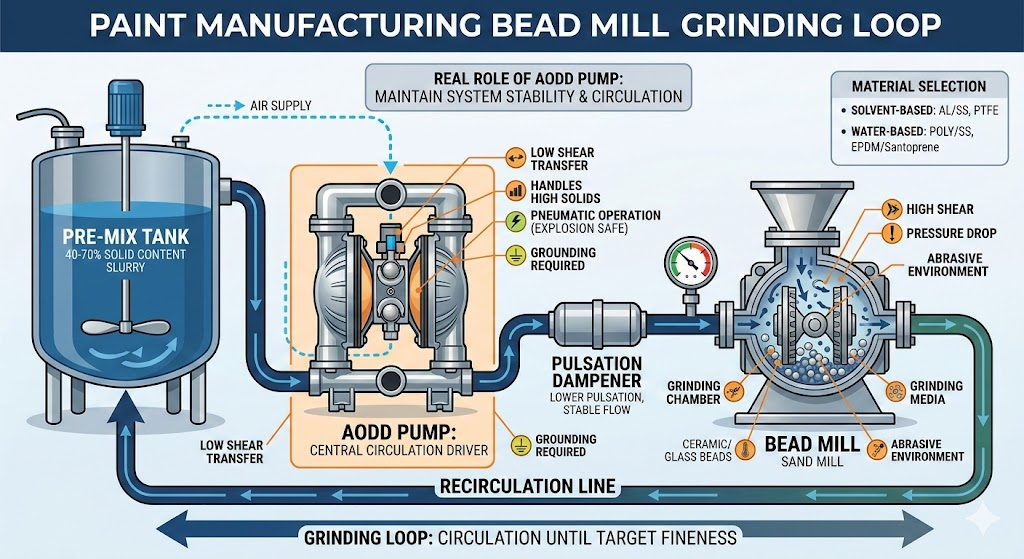
In a typical solvent-based or water-based coating plant, the grinding stage is not a one-pass system. Instead, it is usually a circulation loop:
- Pre-mixed slurry enters the bead mill
- Grinding media (ceramic or glass beads) reduce particle size
- Material exits the mill
- Slurry is recirculated until target fineness is reached
In many medium-scale plants, the circulation is driven by an air operated diaphragm pump.
The pump must continuously:
- Transfer high-solid slurry
- Maintain stable flow rate
- Overcome pressure drop across the mill
- Handle abrasive pigment systems
This is not a simple transfer task. It is a process-critical function.
2. Why AODD Pumps Are Commonly Used in Bead Mill Systems
There are several reasons AODD pumps are frequently chosen over centrifugal or gear pumps in pigment grinding applications.
2.1 Ability to Handle High Solid Content
Pigment slurries can contain:
- Titanium dioxide
- Iron oxides
- Carbon black
- Fillers such as calcium carbonate
Solid content may range from 40% to over 70% depending on formulation.
Centrifugal pumps struggle with such viscosity and solid loading. AODD pumps, due to their positive displacement reciprocating design, can move thick slurry without requiring high rotational speed.
2.2 Low Shear Transfer
Although bead mills apply high shear internally, upstream transfer should not excessively disturb the dispersion system.
Air operated diaphragm pumps:
- Do not rely on high-speed impellers
- Avoid excessive shear in transfer lines
- Preserve rheological structure before grinding
This is particularly important in high-performance coatings and specialty inks.
2.3 Explosion Safety in Solvent-Based Systems
Many coating formulations contain:
- Toluene
- Xylene
- Ethyl acetate
- MEK
These create potentially explosive atmospheres.
AODD pumps operate pneumatically and do not require electric motors at the pump body, reducing ignition risk when properly grounded.
For solvent systems, aluminum or stainless steel AODD pumps with proper grounding are commonly used.
3. The Technical Demands of Bead Mill Circulation
The grinding loop creates specific operational stresses on the pump.
3.1 Pressure Resistance
Bead mills create back pressure, especially when:
- Media loading is high
- Screens are fine
- Viscosity increases during grinding
The pump must overcome:
- Internal mill resistance
- Pipe friction loss
- Filter resistance (if inline filtration exists)
Operating pressure often fluctuates during grinding cycles.
Undersized pumps may stall or lose efficiency under rising viscosity conditions.
3.2 Abrasive Wear
Pigment slurries are abrasive.
Titanium dioxide and certain inorganic pigments can accelerate wear of:
- Valve balls
- Seats
- Diaphragms
Material selection becomes critical:
- PTFE diaphragms for chemical resistance
- Santoprene or polyurethane valve balls for wear resistance
- Hardened metal or thick-walled pump housings
Maintenance intervals depend heavily on pigment type.
3.3 Flow Stability
Grinding efficiency depends on stable flow rate.
If flow fluctuates:
- Residence time changes
- Particle size distribution becomes inconsistent
- Energy consumption increases
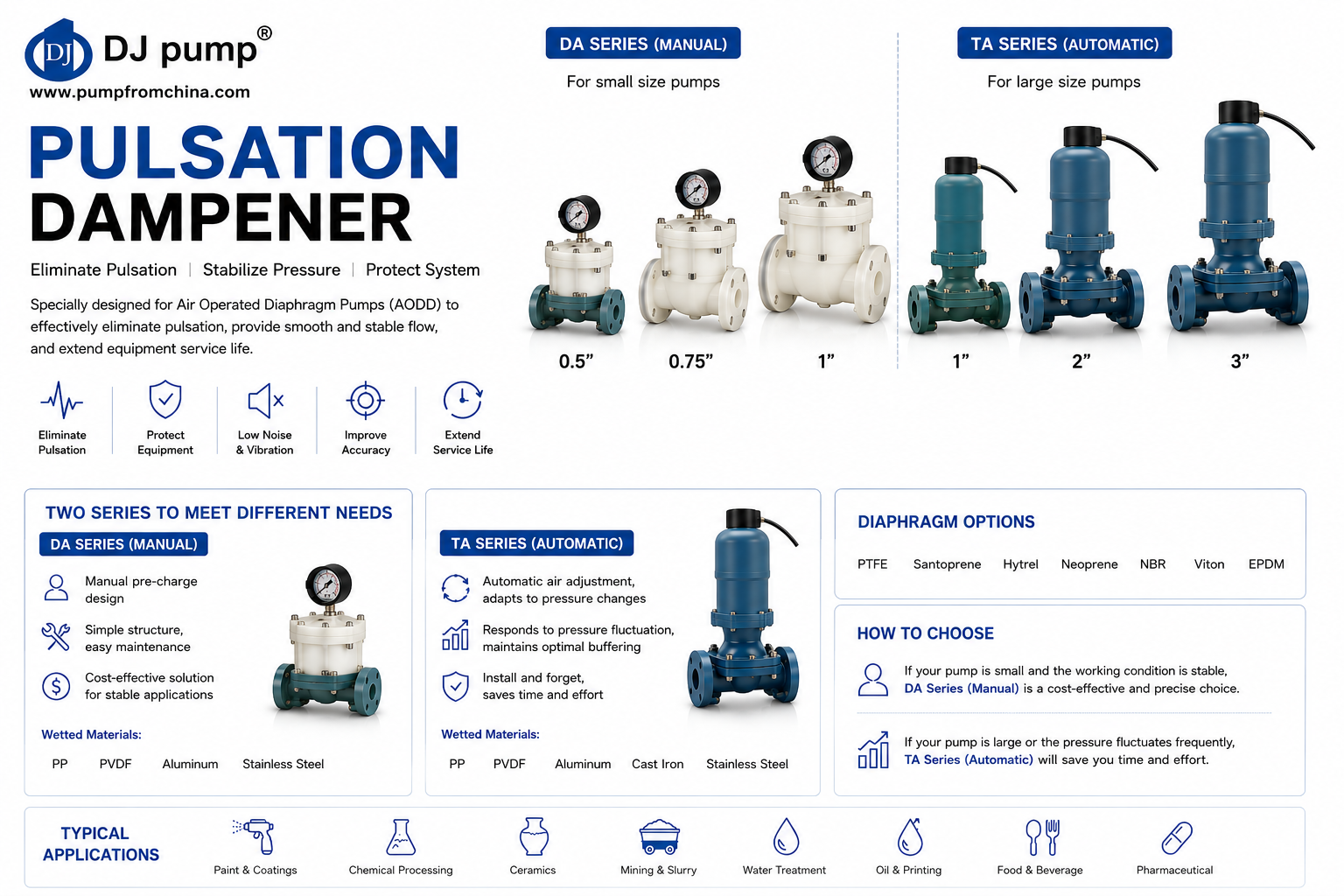
Although AODD pumps inherently produce pulsation, this can be controlled by:
- Proper air regulation
- Pulsation dampeners
- Correct pump sizing
Oversizing the pump often creates more instability than undersizing.
4. Common Installation Configuration in Grinding Systems
A typical installation may include:
- Pre-mix tank
- AODD circulation pump
- Bead mill
- Return line to tank
- Pressure gauge before mill
- Pulsation dampener (optional but recommended)
- Air regulator and filter assembly
The pump is usually placed:
Between the mixing tank and bead mill inlet.
It must be positioned to:
- Minimize suction lift
- Reduce air entrainment
- Avoid dry running
Although AODD pumps tolerate dry running better than centrifugal pumps, repeated dry operation shortens diaphragm life.
5. Material Compatibility Considerations
Besides abrasion, chemical compatibility is also important.
Solvent-based coatings require resistance to:
- Aromatic hydrocarbons
- Ketones
- Esters
Water-based systems may contain:
- Ammonia
- Glycols
- Surfactants
Diaphragm and seal material must be selected accordingly.
PTFE is widely used for solvent systems, while elastomers such as EPDM may suit certain water-based formulations.
6. When AODD Pumps May Not Be Ideal
While widely used, AODD pumps are not universal solutions.
Situations where alternative pumps may be considered:
- Extremely high flow continuous production lines
- Ultra-fine dispersion requiring precise metering
- Fully automated large-scale plants demanding minimal pulsation
In such cases, progressive cavity pumps or specialized circulation systems may be evaluated.
However, for small to mid-sized paint plants, AODD pumps remain a practical and flexible choice.
7. Practical Selection Factors
When selecting an air operated diaphragm pump for bead mill systems, engineers should consider:
- Maximum viscosity during grinding
- Required flow rate under load
- Maximum back pressure
- Solid particle size
- Abrasiveness of pigments
- Explosion protection requirements
- Maintenance accessibility
Pump size is often 1″ to 2″ for typical mid-scale coating production lines.
Oversimplified selection based only on nominal flow rate often leads to operational issues.
8. Conclusion
In paint manufacturing, the bead mill may define dispersion quality, but the air operated diaphragm pump defines process stability.
Its role is not merely transferring slurry. It is:
- Maintaining circulation
- Withstanding abrasive media
- Supporting explosion-safe environments
- Adapting to viscosity changes during grinding
When correctly selected and installed, the AODD pump becomes an integral part of the grinding system rather than an auxiliary device.
Understanding its function within the grinding loop allows coating manufacturers to improve reliability, reduce maintenance interruptions, and maintain consistent product quality.